
60% of searches are predicted to turn into ‘zero-click’ by 2027 as AI Overviews (formerly SGE), ChatGPT, and Perplexity are capable of providing direct and more simple yet useful answers. According to reports, the U.S. has spent almost $1 billion on search advertising and generative AI in 2025, and the figures for the same are expected to reach $26 billion by the end of 2029.
Search engines aren’t just search engines anymore; they have become shopping guides. Today, when you search for a product to buy, you don’t just get options, but advice to select the best one, key features of the product that match your requirements, and even buying tips.
Therefore, it is a must for e-commerce business owners to optimize their website to appear in search results based on modern-day SEO. You don’t just want to rank now, but show up at the right time and right place.
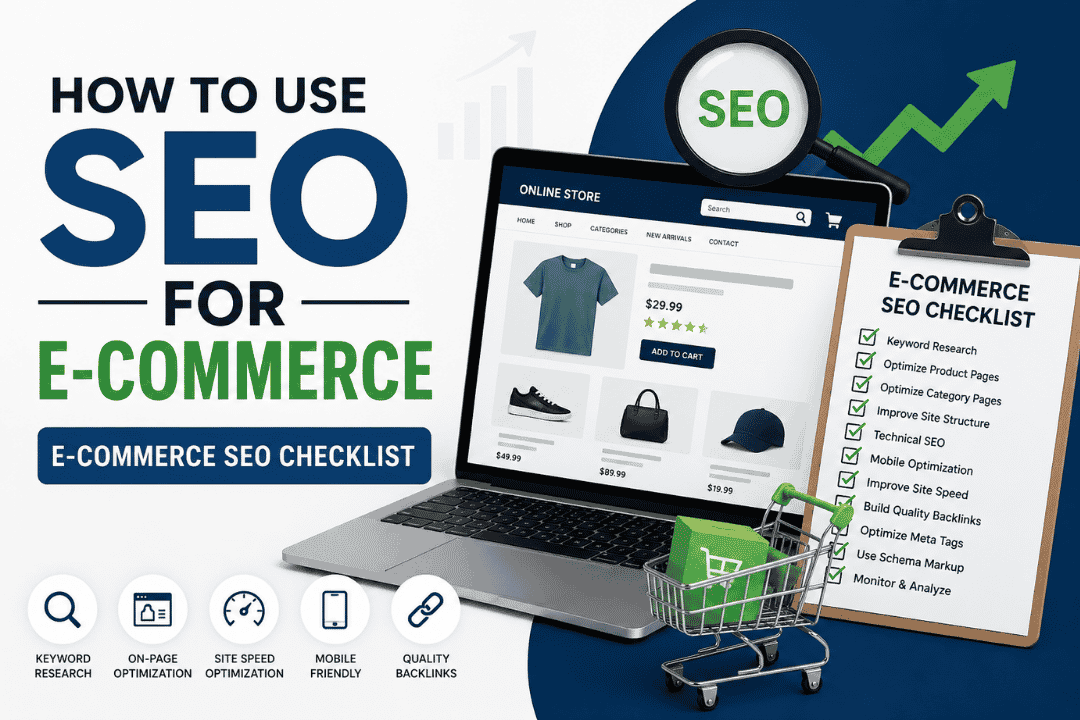
This writing will help you build your e-commerce SEO checklist to flourish, be discoverable, and shoppable across organic listings to AI-driven results.
Traditional SEO vs E-commerce SEO
| Aspect | Traditional SEO | E-commerce SEO |
| Main Function | Attract traffic to landing pages, showing informational aspects or resources on the website. | Driving high-intent buyers or leads that convert into customers. |
| Website Types | Blogs, service sites, news portals, etc | E-commerce website, online stores with product listings |
| Keyword Use | Focus must be on informational keywords | Focus on transactional, commercial, and conversational keywords |
| Content Plan | Articles, guides, blogs, educational content | Product descriptions, UGC, buying guides, reviews |
| Technical SEO Needs | Moderate | Much complex and high needs, as it has indexing issues, faceted navigation, etc |
| Updates | Regular but not frequent. Also depends on updates from search engines | Frequent as it tells about new products, stocks, and pricing dynamics |
| Important Metrics or KPIs | Traffic, rankings, engagement, domain authority, etc | Revenue, conversion rates, order values, etc |
What is E-commerce SEO?

It is the process of increasing the visibility of an online store in the search engine results pages (SERPs).
The ultimate goal is high sales. You need to optimize your complete website, including elements such as product descriptions, listing pages, and catchy visuals, the technical setup of your web store, and more. It also ensures that users can find, compare, and make purchases with ease.
Elements to Focus on in E-commerce SEO
Online store optimization is far more complicated than traditional SEO. The difference lies in structure & strategy: you are not optimizing pages, but building a system that automatically optimizes them. I will take you through each element and try to make you understand with some examples.
1. Keyword Research & Mapping
You must find and use words or phrases that people use to find products and services like yours, and you must pay attention to the search intent.
Here, the major focus is on commercial and transactional words. Also, you do not just research keywords but map them to relevant pages. You don’t create content as per keywords, but instead place those keywords in the relevant category pages.
For instance:
- The keyword is Watch, and the target page will be the homepage.
- If the keyword is women’s watch, then the target page will be the category page.
- If the keyword is a women’s bracelet watch, then the target page will be a subcategory.
- Now, if the keyword is Bvlgari bracelet watch price, then the target page will be the product page.
You can use tools like SemRush’s keyword magic tool, Google, and Amazon’s search features. And also, you can make use of subreddits, i.e., using Reddit for keyword research.
2. Site Structure
It is the most important component of SEO for an e-commerce website for technical optimization. Before you add products, it is important to line up pages properly, such as:
Homepage → Category → Subcategory → Products
Connect the homepage to category pages and then category pages to individual pages on your site.
As there are thousands of pages, a poor site structure or improper URLs can lead to crawling issues and lost rankings. The goal is that users must reach the products in a few clicks and in a hassle-free manner.
Keep in mind that not every page needs to be indexed; for example, you want the Thank You page to appear after purchase and not in search results. Therefore, add a noindex tag to the HTML code of every unwanted page in the search results.
3. On-Page SEO
- Optimize Title Tags
The title tag is something that appears in search results, though Google chooses its own title tag, but optimizing it can be useful as it is the most important part of on-page SEO. It can affect rankings as the searcher uses it to understand your topic.
Incorporate a keyword, keep it under 60 characters, describe the page’s content, and you can use some extras, such as unique offers, discounts, compelling benefits.
- Meta Descriptions
Google does not consider these as a ranking factor, but they can catch the attention of the users as descriptions appear just below the title tags.
Use keywords, keep each page description unique, mention perks, and keep it under 160 characters.
- Build Proper URL Structure
We already discussed the importance of structure, and Google may show the URL in search results to show users where they land when they click on a page. Also, it can use keywords in the URL as ranking factors.
Use lowercase, avoid dates, use hyphens and not underscores, include keywords, and keep it short & descriptive.
- Optimize Product Images
It can be a great factor in Google’s image search results rank and gain additional traffic on the site while increasing brand awareness.
Name the file properly, ‘google-ads.jpg’ is a better name than IMG_1289.jpg. Also, make use of Alt Text for better accessibility.
Tell the search engine a bit about the image using a description, and use compressed images as large files can slow down the web page speed.
- Content Uniqueness
Maintain uniqueness in your content across pages to increase rankings in SERPs. But as there are thousands of pages, maintaining uniqueness can be difficult. Therefore, you can use a simple formula: Product, product name, features, and long descriptions.
When you have these categories, it will be easier to put unique information as each product is different, for instance, the same watch can be in different colors, patterns, materials, designs, etc.
- Internal Linking

It is where you link different pages of your website to each other. It is one important SEO element to boost your rankings by distributing authority across your site.
One of the best ways to apply this on an online store is by linking related product pages, as people usually look for related items that go well with the product. Or items that can be purchased together.
- Schema Markup
It is basically structured data or code added to your page’s HTML, which helps Google understand exact details about your product rather than keeping it guessing.
A product schema includes product name, product price, availability, and ratings & reviews.
Leveraging this element properly can help you with enhanced search results and a rise in click-through rates.
4. Dominate Content Marketing
Content marketing is one of the most rewarding factors to tickmark in an e-commerce website SEO checklist; it includes leveraging videos, blog posts, email newsletters, social media content, and various other formats to promote your brand and content.
The e-commerce funnel is about (top to bottom):
Awareness
↓
Interest
↓
Consideration
↓
Intention
↓
Conversion
↓
Retention
Create BoFu posts to target customers, as these people are high-intent buyers and are more relevant to making a purchase, and the right piece of content can lead to an increased conversion rate. Make use of commercial and transactional keywords.
After creating and publishing content, you must promote it on social media. This increases reach beyond search engines and gives you a wider audience demographic. Along with BoFu content, you can also focus on informational & entertainment content to drive potential interested customers.
5. Technical SEO for E-commerce

Make sure to use a set of rules called Hypertext Transfer Protocol (HTTP), which is a communication protocol between browsers and web servers. HTTPS is a much more secure version of HTTP.
It is a confirmed but nowadays a lightweight ranking factor on Google. To check if it’s working or not, open your website in a browser and look for the lock icon in the address bar.
If it is not present, then you must install a secure sockets layer (SSL) certificate; you can get it from your hosting provider, usually for free.
It also protects confidential information from hackers.
Keep your site mobile-friendly by keeping a check on mobile-friendly readable text, proper spacing between links, buttons, and other clickable elements.
Submit your sitemap to Google; it is essential for commercial websites, as they have thousands of pages.
Focus on improving your page speed, as it is one major ranking factor. Slow-loading speed can increase churn rates. You can improve it by minifying the code and also by using a CDN, a network of servers globally storing copies of your webpages.
Make sure to have regular Site Audits to identify duplicate content, slow page speeds, broken links & images, crawling & indexing issues, and key web vitals issues.
Understand that technical SEO is the most important aspect in webstore SEO, because it consists of thousands and hundreds of pages.
6. Backlinking
Acquiring quality and strong backlinks is one of the meritorious ranking factors to improve ecommerce SEO. They are basically your technical word-of-mouth marketing and promotion factors. The more relevant, reputable, and healthy backlinks you gain, the more trustworthy your site appears in the eyes of Google. You can do this by following these steps:
- Claim unlinked mentions by finding domains that have mentioned your brand/product/service and didn’t link it to your site.
- Use backlink gap analysis to comprehend sites that link to your competitors and not to you.
- Get yourself linked as an official seller with suppliers or distributors.
Conclusion
Search engine optimization for e-commerce websites has become a predestined process if you wish to scale your online store. Search engines are just search engines, but have turned into shopping preview stores. The advancement of artificial intelligence in search engines brought up new variations in how consumers look at and purchase products. Therefore, retail SEO is a boon to serve you with solutions to these challenges. In this, we explored what the actual difference is between traditional and ecommerce SEO and what the best tips are to successfully tickmark your SEO checklist for an e-commerce website.
FAQs
1. What are the most useful tools for SEO for an online store?
You can use the following tools to solve different issues in ecommerce SEO:
- Google Search Console for indexing, crawling issues, and keyword performance.
- Moz Pro for keyword tracking, domain authority, and site audits.
- Screaming Frog SEO Spider for technical SEO aspects.
- PageSpeed Insights for monitoring performance and checking on core web vitals.
2. What are the challenges in implementing SEO for an online commerce website?
Some of the major difficulties are duplicate content, as there are thousands of pages with similar products but with minor or a few differences in them. Another one is the management of numerous pages, site speed issues, dealing with issues related to out-of-stock products, and keeping a balance between SEO and user experience.
Related: 7 Best eCommerce Website Tools for Growing Your Online Business
Related: How Marketing and Development Drive eCommerce Success