

Single-page applications are loved by many users, and we use them daily. Are you also wondering what these are? These are your social media and work-related apps. Applications such as Slack, Grammarly, OTT platforms, Airbnb, and more are simple examples of single-page applications (SPA). The most liked thing about these apps is the smooth and fluid user experience. They keep users engaged with their dynamic content loading that avoids the halt of full-page reloads. But this has created significant challenges for SEO practices, and to solve these, you need to have a strong single-page application SEO strategy.
In this blog, I will take you through the exact mechanism of SPA SEO such as SSR, hydration, and more. We will also learn how all this is implemented.
What is Single Page Application SEO?
As I said, SPAs do not reload pages for every interaction; instead, they simply jump from one view/route (informally, screen) to another on the same page. Now, in this process, it is harder for search engines to crawl and index content, which can lead to issues like blank pages, missing unique URLs, and more.
Let’s understand this with an example:
When you open Netflix in a browser, you see different options, including home, search, movie details page, and watch page. Now you may think of them as different pages of a website, but they are not. It is just a single page when you open the website; however, the different options that show up on the interface are called route pages or sections of that one particular app.
When you click on these options, only the URL fragment (not the complete URL) changes, not the entire page, i.e., you see the page does NOT reload, and just the content on your screen is changed.
All this is possible because of React and other frameworks from the JavaScript library. Now, when someone searches for a movie or series on Google, they visit Netflix and encounter an empty page (HTML code with no content or information), then JavaScript runs and fills the information, such as images, movie names, and texts.
But the catch is, Google may not wait so long for this content to load, so when there is a delay or improper handling, then it might think that the page is empty and will not crawl through your web page (in case of SPA, your website) in the search results.
Search engine optimization for single-page applications is a process where these issues are solved using techniques like prerendering, dynamic metadata setup, building a crawlable foundation, etc. It makes sure that even if the JavaScript wasn’t fully working at the helm by the crawler, even then, your content is visible and rank able on SERPs.
The Marrow SEO Difficulties in Single-Page Apps

Before understanding how SPA SEO works, you need to understand why it is needed, because in this SEO type, it is crucial to know the challenges first to better understand the solutions.
1. High Reliance on JS Rendering
All JS frameworks are by default set to use client-side rendering (CSR), which means the website is fully rendered (converted into visible content) in the browser and not on the server. Hence, there is little to no site information in the initial source code, leading to a high dependency on rendering JS to load the whole page’s information.
It may seem fine to users, but it involves several steps for a search engine to index a site:
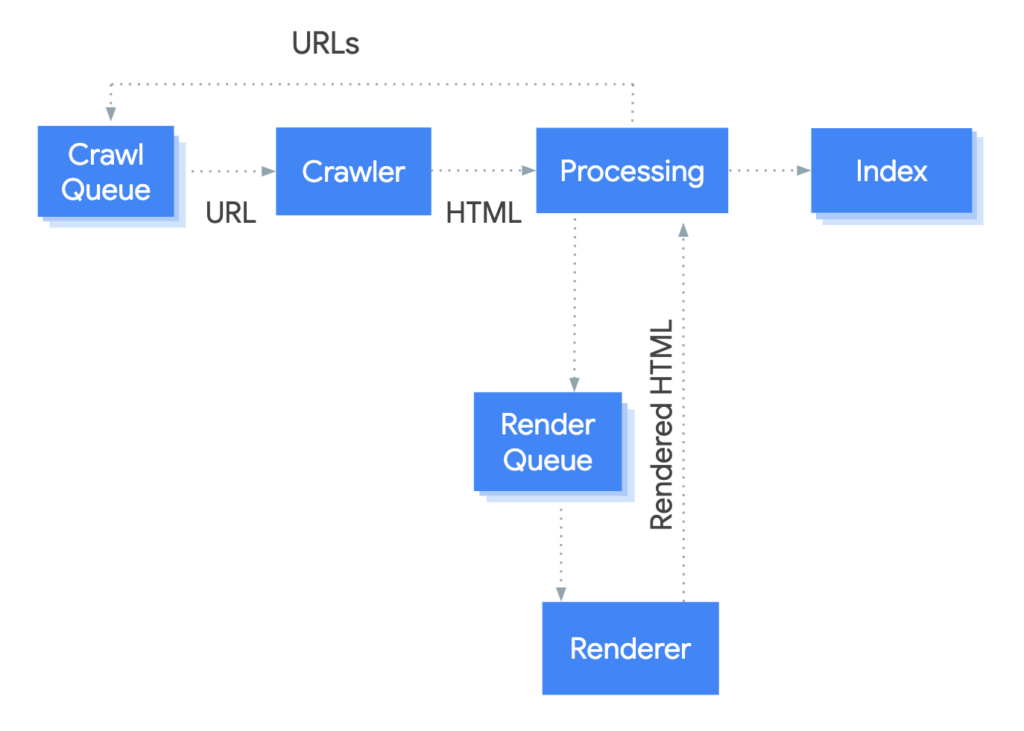
So if the crawler doesn’t perform efficiently, it can miss out on information in search results, due to incomplete indexing.
This is the root cause of the blank page problem; it can lead crawlers to see your content-rich SPA completely blank, as they do not find anything to index.
2. Inefficient Meta Tags
The page titles, descriptions, and open graph tags that control URL appearance (media previews) across sharing on social media change rapidly while traveling between route pages. But these changes happen via JavaScript, creating a high risk of details not being captured correctly.
For instance, if all pages within an SPA share the same HTML file and fail to reload when navigated by a visitor, how will metadata change? And SPAs will display the same metadata for each page, which is not how it should be.
3. Fragmented URLs
Search engines prefer a separate URL for each page, but in SPAs, there is only one HTML file, and JavaScript puts content into it. So, during navigation by the user, the browser URL doesn’t change, but only the hash fragment at the end of it is updated, showing the new state of the application.
It is a boon for developers but a bane for SEO.
Search engines disregard fragments and do not crawl them as individual URLs. This results in incomplete or no indexing by crawlers, which consequently means no information to rank in search outcomes.
4. Specific Need of JavaScript even with Rendering Solutions
Let’s say even if you have made your website SEO friendly by implementing prerendering or SSR techniques, but still, the parts of your website will rely on JS to be comprehended by a search engine.
Search engines read HTML easily, but crawlers must perform to understand those parts using JS.
This is also a reason for other problems, such as delayed & slow indexing, incorrect or missed indexing, and sometimes no indexing at all.
5. Performance Issues
The user experience and SEO performance assessment is done by critical Core Web Vitals, which are:
- Largest Contentful Paint (LCP)
It is responsible for measuring how fast the main visible content loads, which means when the largest content element is painted on the screen. It tracks time-to-first-byte and document size.
But in SPAs, content loads after JavaScript execution, which indeed delays rendering and leads to poor LCP.
- Interaction to Next Paint (INP)
INP has replaced FID (First Input Delay), which was about how fast a page responds to user interaction (clicks or any action on the website). It is the same about INP as well, but INP not only measures the first interaction but offer the holistic view of the overall responsiveness, i.e., all interactions.
But due to excessive work by JS files, the browser is engaged, and then the hydration process adds more work to it by re-running. And because of all this process, user interaction is delayed, which means slower response time and poor INP.
- Cumulative Layout Shift (CLS)
CLS tells about the visual stability, that is, the robustness of a page, capturing unexpected layout shifts throughout a user’s session. The largest CLS score is at the end of the session and is credited to the landing page.
But the dynamic content rendering in SPAs becomes the reason for late content and UI shifts, which in turn results in high CLS.
The stumbling blocks in all these core web vitals affect the efficiency of SEO, and all of it constitute to constrained performance.
6. Crawlers Can’t Find Pages
Since SPAs often use handlers instead of real anchor tags, crawlers are not designed to follow them, and thus, pages remained undiscovered.
Since the navigation is dependent on JS, if it is not executed properly by bots, it can come out as incomplete crawling.
Factors such as hidden or slow content loading, poor internal linking with no clear crawl path, broken routing, and limited crawl budget efficiency because bots may waste time rendering JS processing pages.
All of this ends in crawlability and discoverability issues, and makes pages invisible to crawlers.
Solving SEO for SPA

1. Implementing Server Side Rendering (SSR)
In SPAs, since dynamic content loading relies on JavaScript, search engines need the complete HTML file in the HTTP response for complete crawling, indexing, and access.
But when you use SSR, which means before the page reaches the browser, it is already rendered on the server. So now Google can see a complete and fully ready HTML page.
It helps in better indexing, faster page loads, and supports Google in reading content immediately.
Can use Next.js for React, Nuxt.js for Vue, and Angular Universal for Angular JavaScript.
2. Pre-rendering
It is used for static routes that show the same content to every visitor. When you pre-render, it means pages are generated in the form of static HTML files even before deployment. Which means even before the website goes live, all pages are pre-made for visitors to receive ready HTML files instantly.
3. Clean URLs
Use complete URLs instead of hash URLs, it must be short, readable, and keyword-focused. This is important as it helps users and search engines to understand what the page or its content is about.
Also, URLs must follow a structure or hierarchy, for example, homepage/services/hair smoothing/, which shows your website as less complicated and logically organized.
Use canonical tags to avoid URL duplication; sometimes the same page can have various URLs, which might all seem the same, but Google considers them as different pages. And these tags tell Google about the main URL and ignore all. Thus, SEO effort goes to one page instead of being split.
Now comes the part where you need to help search engines prioritize your URLs, and that is done by submitting an XML sitemap to Google. It is basically a list of all your important pages. Whereas a robots.txt file submission is done to make Google understand which sites it must not crawl. Both these steps help in preventing waste of crawl budget and help focus on essential content.
Last but not least, URL parameters [the parts after (?)] must be dealt with caution as they can create multiple versions of the same page, and improper management can dilute your SEO performance.
4. Technical Solutions
- When working on the History API, search engines often ignore everything after the hash, so you must avoid using # in URLs for SEO pages. Make use of the HTML5 History API to make sure every page has a unique and clean URL for individual indexing.
- Crawlers work by following links; they do not use click buttons or carry out JavaScript commands. Hence, for link discovery, give every link its standard anchor tag.
- Dynamic Metadata management is another crucial technical aspect. When a SPA page is swapped, the title, description, and canonical tag must be updated. In pure CSR, these updates take time, while in SSR, you can pack these in the initial HTML. And use the meta tag checker for verification.
5. Optimize for AI Search Engines
Artificial search engines are highly skilled at sourcing web content, though their crawling behavior is still shedding skin; some patterns are still worth considering.
Adding schema markup gives exact details about your content on the page. A product schema containing offers and prices will be more reliable than price text cluttered across pages.
Use semantic HTML to help crawlers distinguish between core content and navigation chrome.
Also, AI responses are pretty direct and to the point. You must optimize your content in clear, concise formats for it to be cited in AI overviews, and this will act as a ranking factor.
6. Internal Linking
It is essential to implement clear internal linking between all routes on a single page for crawlers to easily navigate through the site.
As SPAs rely on CSR, a lack of a clear internal link structure can lead to discovery gaps in pages. Include proper anchor tags and href attributes that show the actual path and avoid onClick handlers without meaningful URLs.
Link important pages to other parts of the application, especially from the homepage and high-authority pages, for relevant signals supporting efficient crawling.
Adhere to logical hierarchy and put descriptive anchor text that reinforces page topics.
This linking solution will improve crawl depth, distribute authority, and strengthen overall SEO across the application.
Final Word
Single-page application is today’s most widely used and appreciated application of time, giving users a hassle-free and overall glossy experience. But they work on such software technologies that make it difficult for search engines to do justice to them in rankings and visibility.
The dynamic content loading and no reloads have a lot going on at the backend, and they create several SEO challenges, such as poor website performance, a need for specific JavaScript rendering solutions, tailored technical measures, low or no page discovery by crawlers, blank pages, and more. I have mentioned no-fluff solutions to these problems in SEO for spas.
We also saw what SPAs are and what their technical base is, and how SEO for single-page applications is far different from the traditional SEO process. I hope you find this writing useful on your way to exploring SPAs and their intricacies.
FAQ
What is hydration?
It is a process to add life to plain HTML, where users can see content, but it is mostly static. When hydration happens, JavaScript works and makes the page interactive by enabling features such as clickable buttons, forms, sliders, and CTA features.
What are bundle issues in SPA SEO?
In SP apps, the website runs mainly on JavaScript, and all the code is packed into files called bundles. Now, if these bundles are too packed or not structured properly, when processed, they slow down your site. This makes it difficult for search engines or bots to crawl and index. And users might leave even before the page becomes interactive.
What is the difference between Server-Side Rendering (SSR) and Re-rendering?
In SSR, the page is fully built on the server before it reaches the user on the browser, i.e., a content-filled, interactive HTML page. Which is great for SEO, and Google doesn’t have to wait for JS execution. Whereas in Rerendering, all this process happens on the browser, after the page loads, JS starts working to update and rebuild parts of the page called out by the users or update the data or app state.
What is dynamic rendering?
It is a type of rendering method where different versions of websites are displayed to different types of visitors. For example, when a regular user opens the website, they will see a usual interactive SPA version. Whereas, when a search engine crawls through the website, it is shown a prerendered HTML version sent by the server.
Related: Top 5 Social Media Monitoring Software and Tips to Choose the Best Software?
Related: How to Make a Blog Stand Out using AI