
Want to know how Google connects your business to people looking for your product or service? It sounds fascinating, but not as easy as it seems. The process involves strategic digital marketing and advertising techniques. One such way of doing it is running Google Ads for your business. Google Ads ROI is forecasted to reach $340.18 billion by 2027.
In this blog, I will guide you to leverage Google Ads by using its keyword bidding strategy. We will learn performance-based advertising and various other vital aspects of Google Ads.
What Are Google Ads?
Google Ads is a digital advertising platform by Google (a product of Google) that businesses use to promote themselves. It can help you sell products or services, raise your brand awareness, and increase traffic to your website. It can serve you with the following perks:
- Full online management of campaigns for better flexibility
- Instant changes or adjustments as per need
- No minimum amount, decide your own budget
- Decide how, when, and where your ad appears
- You can easily calculate Google Ads’ return on investment.
How Do Google Ads Work?
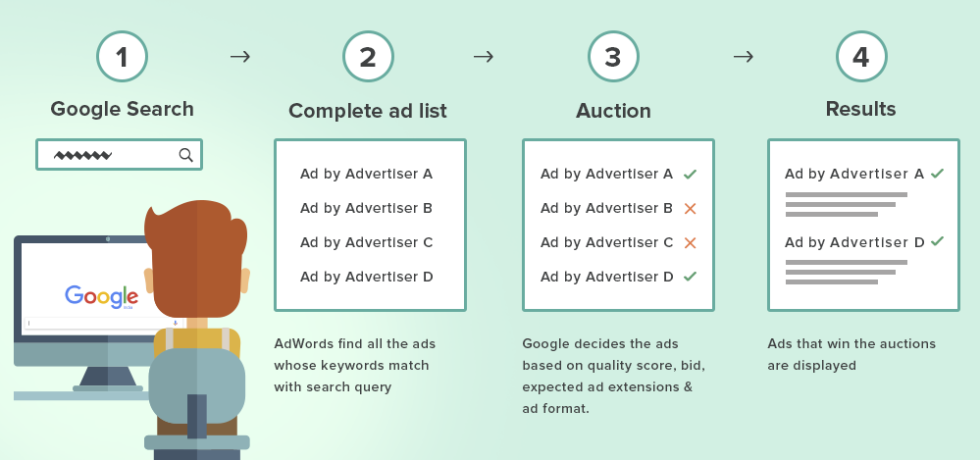
Previously known as Google AdWords, Google Ads is one of the most popular and used pay-per-click advertising platforms in the world.
To use Google Ads, basically, you bid on chosen keywords with the amount of money you are willing to spend per click. The keywords are thoroughly researched words or phrases that are highly used in search queries by individuals searching for a particular product or service.
When a user performs a search and they use the words or phrases that are keywords bid by you, Google will display your ad above the organic search results page. And this is a great way of attracting potential customers by strategically optimizing a simple Google search.
Types Of Google Ads
1. Search Ads
These are ads that appear on search engine results pages (SERPs). When there are searches containing keywords relevant to your bid, the ads are displayed alongside organic search results. Advertisers must understand the optimal ad placement, because when a user searches for, Google’s algorithm places the ad with the highest bid keyword at the top.
These ads are generally marked as ads to distinguish them from organic search results. You only pay when a user clicks on the ad.
2. Display Ads
The purpose of these ads is to build brand awareness and visibility. Display ads are often images, videos, or graphics with text. They are advertised on websites, mobile apps, and other online platforms across the Google Display Network (GDN). These are commonly used for retargeting customers who bounced without purchasing.
3. Video Ads
Video Ads focus on storytelling and highly appealing content to attract customers. These ads are placed in various formats, such as skippable in-stream ads that appear before, during, or after you play any video on YouTube.
In-feed video ads are the ones that appear alongside YouTube search results as thumbnails. Non-skippable ads, up to 15 seconds, that are played before a YouTube video. Outstream ads appear on the partner website and apps across GDN.
All these types of video ads have a certain criterion; you only pay if that criterion is fulfilled.
4. Local Ads
These are of best use for local businesses around the area; the Google Local Services (LSAs) allow local vendors to reach potential customers. These appear in search results like the ‘name of the service’ near me. After passing the screening and verification process, you are awarded a Google Guarantee Badge. The advertiser only pays when someone contacts or requests the services.
5. Shopping Ads
Do you see many options with a picture and written information under it when you search for, let’s say, White Sneakers? The image of white sneakers appears with information about its price, brand, seller, or store name, and often rating and reviews. These pictures with descriptions are called shopping ads. These ads always give the latest information about the product, as the information is directly taken from the Google Merchant Center. And they also serve as a small & quick guide.

Are Google Ads Worth It for E-Commerce?
Businesses can generate up to 200% ROI, which means they make $2 for every $1 spent on Google Ads. It holds 80.20% of the market share of PPC. There are businesses that are leveraging AI in their Google Ad strategies. The CPC conversion rates sometimes outperform organic traffic by 50%.
Advertising is not a piece of cake; it requires extensive resources and hefty pockets, but the digital world has made it easy. And Google Ads is one of the prime examples, from small to large-scale businesses and from e-commerce to manufacturing companies, all can leverage advertising and marketing in a cost-effective and impactful way.
Google Ads Vs SEO
| Google Ads | SEO |
|---|---|
| Type of outbound marketing | Type of inbound marketing |
| Works across and with Google networks and partners | Works on searches, algorithms, and is backed by content marketing |
| Targets are specific and yield the visioned outcomes | SEO is more about gaining organic search, which can be converted to derive outcomes |
| High speed and immediate results, and so is the cessation process | Slow, organic, scalable, and over time process |
| Initial hard efforts to set up a campaign, then results can be benefited from optimizations & updates | It is a continuous work, consisting of routine on-page processes and updates |
| You deduce the budget. Google ads are based on PPC models. | There is no cost, but efforts such as content production and more are required |
Conclusion
So far, understanding how Google ads work, it is one of the best and efficient ways of advertising. The keyword bidding strategy allows you to have control over the budget and outcome goals. Google Ads gives you the flexibility to tailor campaigns, formats of ads, and time limits as per your needs. And that makes Google ads worth it for e-commerce and small businesses.
So choose your price, your ad model, and let your potential customers be your regular buyers by putting Google Ads to use.
Related: From Clicks To Courtrooms: Mastering Google Ads For Lawyers
Related: Social Media vs Email Marketing in 2026: Which Is Better?